
Sponsored
The Macro Force That Moves Technology Markets — and Why Most Investors Never See It Coming

There is something driving technology markets that most investors never track.
Not earnings. Not Fed statements. Not analyst upgrades or downgrades. Not the news cycle.
The biggest moves in technology stocks over the past decade — the surges that made fortunes and the crashes that wiped them out — follow a pattern that has nothing to do with any of those things. Most investors only discover this after the damage is already done.
The question worth asking
Why do technology stocks move so dramatically, so consistently, in the same direction at the same time?
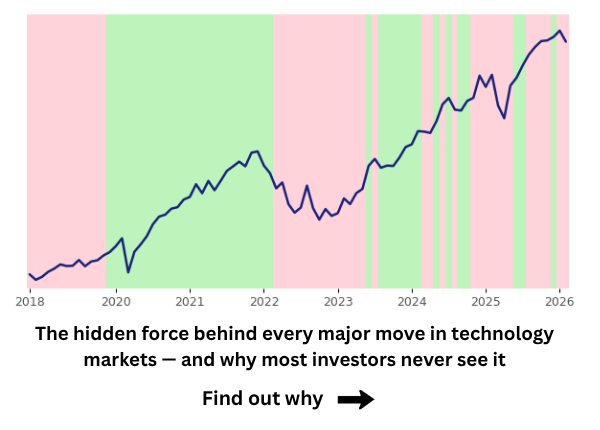
In 2020 and 2021, almost every major technology company surged — regardless of their individual earnings, regardless of their sector, regardless of their specific fundamentals. In 2022, almost every major technology company fell — again, regardless of individual performance. The same pattern has repeated across multiple market cycles, in both directions, with a consistency that is difficult to explain if you’re looking at company-level data.
Something else is moving the whole sector simultaneously. And most retail investors have no idea what it is.
The explanations that don’t hold up
When technology markets move sharply, investors reach for the obvious explanations. Interest rates. Earnings seasons. Geopolitical events. AI hype cycles. Regulatory risk.
These explanations feel satisfying in the moment. Financial media reinforces them constantly. But they don’t hold up under scrutiny.
If interest rates were the primary driver, you would expect technology stocks to move predictably in response to Fed decisions. They don’t — not consistently. If earnings were the driver, you would expect individual company performance to determine individual stock performance. It doesn’t — not when the whole sector moves together. If AI hype were driving the current cycle, you would expect the surge to be concentrated in AI-specific companies. It isn’t.
The same companies surge and crash together regardless of their individual news. The same sectors move in unison regardless of what is happening at the company level. Something upstream of all of these explanations is driving the bus.
The variable professionals track
There is a variable that flows through the entire global financial system. It expands and contracts in cycles — sometimes gradually, sometimes sharply. When it expands, capital flows into risk assets. When it contracts, capital is withdrawn from them.
RECOMMENDED READING

Why every major move in technology markets happens at the same time — and what’s really driving it
5 min read — Read more

The macro force professional investors watch closely — and most retail investors never track
4 min read — Read more

What the 2020 surge and the 2022 crash had in common — and why it matters for AI stocks now
5 min read — Read more
Professional macro investors have tracked this variable for decades. It sits at the centre of how institutional money managers think about market positioning. It is not a theory or a hypothesis — it is one of the most well-documented relationships in modern financial markets.
That variable is global liquidity.
Not interest rates, though interest rates influence it. Not money supply in isolation, though money supply is one component. Global liquidity is a broader measure — the total supply of money flowing through the financial system at any given time, across central banks, governments, and financial institutions worldwide.
Why technology stocks are uniquely sensitive
Technology stocks respond to global liquidity conditions more dramatically than almost any other asset class. The reason is structural.
Technology companies are long-duration assets. Their valuations are based on future earnings — often earnings many years into the future. This makes them uniquely sensitive to the cost and availability of capital. When liquidity is expanding and capital is cheap and abundant, the present value of those future earnings rises sharply. When liquidity contracts and capital becomes scarcer, the reverse happens.


This is not a coincidence or a correlation that occasionally holds. It is a structural relationship that has played out consistently across every major market cycle of the past decade. The 2020 surge. The 2022 contraction. The subsequent recovery. Each of these moves tracked global liquidity conditions with a consistency that no other single variable can match.
The retail investor problem
Here is where the problem lies for most individual investors.
Professional macro investors who track global liquidity do so with institutional-grade resources. Dedicated research teams. Proprietary data feeds. Frameworks developed and refined over decades by some of the world’s most respected independent macro analysts. They have the infrastructure to monitor multiple data sources simultaneously, interpret the relationships between them, and apply a consistent methodology through volatile and often contradictory market conditions.
For the individual retail investor, none of that infrastructure exists.
Most retail investors are making technology investment decisions based on earnings calls, news headlines, analyst commentary, and market sentiment. All of which are lagging indicators — they reflect what global liquidity has already done, not what it is doing now. By the time the shift in liquidity conditions becomes obvious in the headlines, it has already happened in the market. The investor who relies on news to guide their positioning is always reacting, never anticipating.
This is not a failure of intelligence or effort. It is a structural disadvantage. The information exists. The framework for interpreting it exists. But maintaining that level of analysis consistently — month in, month out, without the research infrastructure that professionals rely on — is not realistic for someone managing their own portfolio alongside everything else in their life.
What changes when you track the right variable
An investor who understands global liquidity conditions doesn’t need to predict the news. They don’t need to interpret earnings calls or follow Fed press conferences looking for signals between the lines.
They need to know one thing: whether current conditions favour technology exposure or suggest caution.
That single piece of information — updated monthly, grounded in the same framework institutional macro investors use — changes the nature of the decisions an investor makes. Not because it predicts every move. No macro framework does. But because it tracks the environment. And tracking the environment — being more exposed when conditions support technology assets and more cautious when they don’t — is what separates systematic investing from guesswork.
For investors who want to understand what this looks like in practice — and what the historical record shows when this framework is applied consistently to technology markets — the resources on this page are the starting point.
FURTHER READING
Why AI stocks can fall sharply even when the underlying companies are doing nothing wrong
4 min read — Read more
 </
</